


From research to practice: The practical efficiency of NOx treatment systems in major cement plants
In recent years, controlling industrial exhaust emissions has become a mandatory requirement for the cement industry – one of the industries that consumes a lot of energy and generates a large amount of pollutants during production. Among these, NOx is a notable emission component due to its potential to cause air pollution, acid rain, and affect public health.
Along with increasingly stringent environmental regulations, cement plants in Vietnam are facing the need to invest in and apply effective emission treatment solutions. According to QCVN 41:2011/BTNMT and the requirements of the Law on Environmental Protection 2020, NOx emission control has become a mandatory requirement in the operation of production lines.
In this context, SNCR (Selective Non-Catalytic Reduction) technology is considered a suitable solution due to its relatively high treatment efficiency, ease of integration into existing systems, and reasonable cost.
A suitable solution for the cement industry
One of the favorable factors for applying SNCR technology in the cement industry is that clinker production lines usually operate stably for long periods with little fluctuation in temperature and exhaust gas flow rate, creating suitable conditions for SNCR technology to be effective.
In addition, compared to NOx treatment technologies requiring catalysts, SNCR is simpler, more compact, easier to install, and
does not significantly change the factory’s technological process. The cost of NOx treatment using SNCR is typically only a few
tens of thousands of VND per ton of clinker or finished cement, depending on the input NOx concentration and the type of chemicals used. This cost is considered reasonable by many businesses compared to the environmental efficiency achieved.
From testing to technology optimization
The early years of SNCR implementation in Vietnam were a period of “learning by doing and perfecting the technology.” Initial projects implemented by the Labour and Environment Protection Center (LEC) mainly assessed the adaptability of domestically manufactured equipment to the actual conditions of clinker kilns.
The biggest challenge during this period was finding solutions for using nozzles, determining the appropriate nozzle placement, selecting the reducing agent, and optimizing the mixing capacity in the gas stream. Some initial systems, while meeting operational requirements, did not achieve the expected NOx reduction efficiency or had high chemical consumption.
Practical implementation showed that the efficiency of SNCR technology depended significantly on the operating characteristics of each clinker kiln. Differences in temperature, flow rate, and gas stream distribution meant that each production line required its own design solutions, rather than applying a unified technical configuration to all plants.
Following the testing phase, SNCR technology was gradually optimized. Many systems were designed to be more flexible with various injection positions to maintain the optimal reaction temperature range. Simultaneously, the application of an automatic control system helps control the flow rate of NH3 or urea according to the furnace load and the output NOx concentration, limiting
unnecessary chemical consumption.
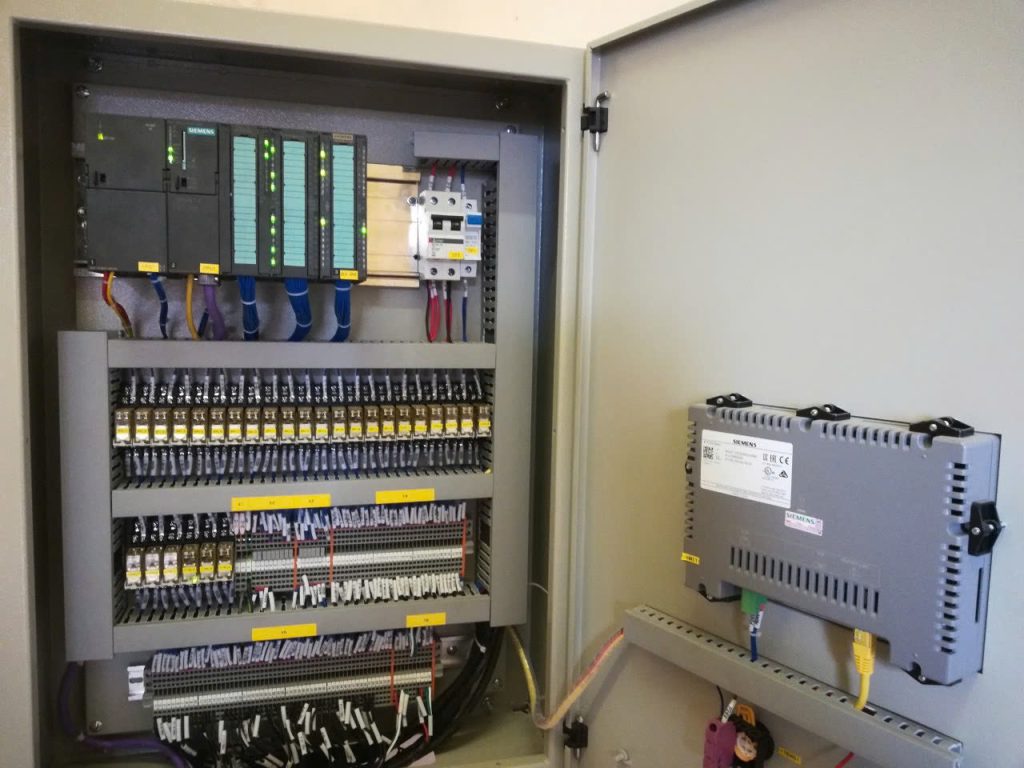
PLC cabinet for automatic system control
Factors affecting treatment efficiency
Although considered a relatively simple technology, the efficiency of SNCR still depends on several important technical factors.
Among these, the reaction zone temperature is a key factor. If the temperature is too low, the NOx reduction reaction is inefficient; conversely, if the temperature is too high, the reducing agent may be re-oxidized to form new NOx.
In addition, the structure of the injection nozzles and the capability to mix chemicals with the exhaust gas stream also directly affect treatment efficiency. Currently, both NH3 and urea are used as reducing agents in Vietnam. NH3 offers better reaction efficiency but requires strict operational safety standards, while urea is more convenient for storage and handling.
Practical efficiency at cement plants
After years of implementation and optimization, SNCR technology has proven its efficiency in many major cement production lines in Vietnam.
Actual operating results show that the common NOx reduction level reaches approximately 30–50%, and in some cases, it can be even higher when the system is well optimized.
The output NOx concentration at plants that have installed the system has decreased below current regulatory limits without requiring major changes to the production line structure.
Not only achieving treatment efficiency, the system is also highly valued by enterprises for its stability. After the initial adjustment phase, the system can operate continuously under kiln load with high stability, without affecting clinker quality or production capacity.
Affirming the capacity to implement and master domestic technology
The successful implementation of numerous SNCR projects at major cement plants demonstrates that LEC’s technical team is fully capable of mastering advanced NOx treatment technology, from surveying, designing, and manufacturing equipment to installating, operating, and optimizing the system.
Through practical implementation, LEC has accumulated a rich operational database and indepth experience with various clinker production lines. This is a crucial foundation for further refining technical solutions suitable for production conditions in Vietnam, while reducing dependency on imported technology.
Conclusion
In the context of increasingly stringent emission control requirements, SNCR technology has proven to be a viable and suitable solution for the Vietnamese cement industry.
From early deployment projects to the current stable operating systems, SNCR has not only helps reduce NOx emissions but also contributes to promoting the transition to a greener and more sustainable production model.
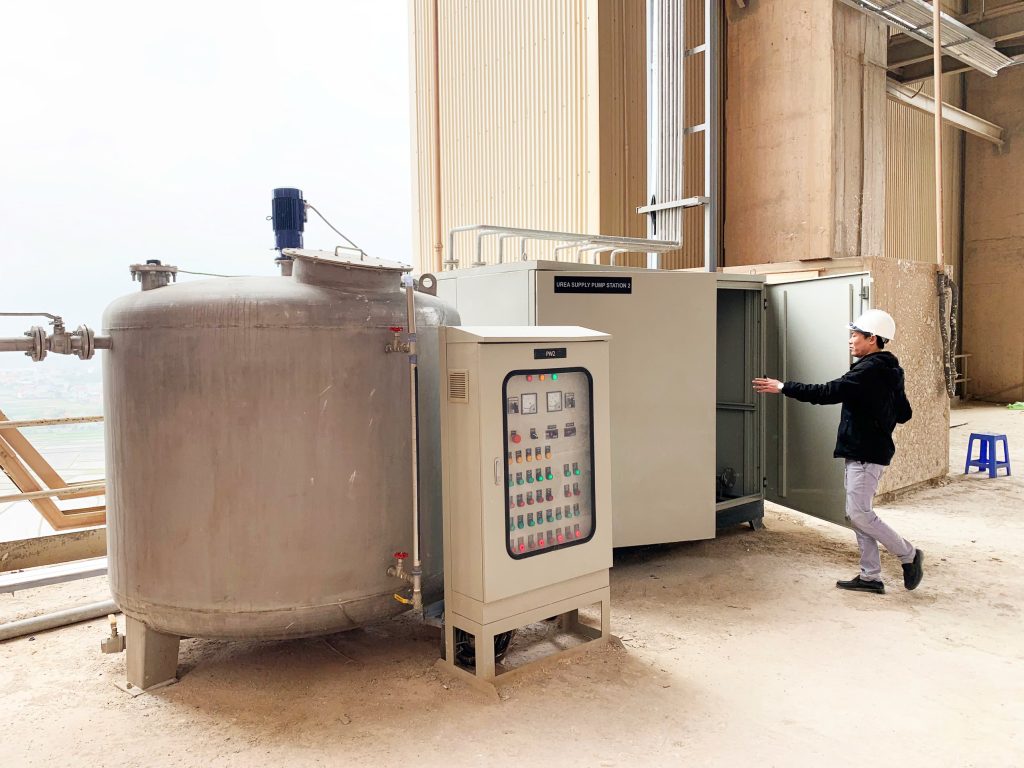
Secondary distribution system


